
In creative contracts, "unlimited revisions" is a pricing structure that allows a client to request an infinite number of alterations to a work-in-progress before final delivery for a single flat fee. On paper, it sounds like the ultimate safety net for a nervous buyer. In reality, capping edits at two or three structured rounds protects the client's launch timeline and keeps the visual concept sharp, whereas open-ended clauses drain momentum from both sides of the desk.
What Unlimited Revisions Mean and Why Three Rounds Win
Every creative entrepreneur has watched a great illustration lose its spark inside an endless feedback loop. When you sit down with your Wacom tablet to kick off a commissioned piece, both you and the buyer want a smooth ride to a gorgeous final file. Offering infinite edits for a flat fee actively sabotages that goal.
Two or three structured revision rounds give the client defined decision points, protect the launch schedule, and help preserve a coherent visual direction. A tight commission workflow rests on three essential pillars:
- Stage-gate approvals: Breaking the artwork into sequential phases so foundational choices get locked in before final polish begins.
- Clear boundaries between tweaks and redraws: Defining what counts as an included adjustment versus a billable change in project scope.
- Consolidated feedback: Training buyers to gather all stakeholder notes into one unified message rather than dripping contradictory requests over several days.
Wait until you see how calm a project feels when you separate revision rounds from approval checkpoints. A standard commission can feature four distinct checkpoints without promising four full rounds of edits. For example, a two-round package typically places one editing round right after the Concept Thumbnail and a second round at Color Block-In. If a client wants a three-round package, you simply slot an extra editing round into the Refined Line Art phase. Under this proposed contract window, the schedule allows 1 to 2 business days for the client's consolidated response at each checkpoint, keeping everyone moving forward.
Decision Fatigue and Diluted Art: How Endless Edits Backfire on Buyers
Why do open-ended agreements stall out so badly? When approval can always be postponed, a client may reopen settled choices and solicit more opinions from people outside the project. Without a hard stop, buyers second-guess their own instincts.
This triggers a classic "design by committee" decay. An energetic, cohesive initial sketch gets chipped away through a dozen tiny, conflicting requests until the final piece feels completely sterile. One stakeholder asks for a restrained palette, another requests brighter accents, and a later reviewer removes the contrast that made the focal point readable in the first place.
Consider a composite studio scenario that illustrates how quickly this derails a business goal. Imagine a boutique beverage brand commissioning a hero illustration for a seasonal release. The project starts with a reasonable 10-to-15-business-day production plan and a firm artwork handoff deadline set three business days before launch. Because the contract promises unlimited revisions, the founder keeps tweaking the background hue. Microscopic color requests arrive individually every 1 to 2 business days—a little warmer on Tuesday, slightly more teal on Thursday, back to the original shade on Monday. That trickle of micro-edits extends the approval loop by 10 to 15 additional business days.
The operational consequence hits hard. Without approved artwork three days before launch, the client cannot finish the product-page graphics and packaging mockups scheduled for the release. The product launch slips, marketing spend gets wasted, and the illustration looks overworked.
Of course, a high-budget agency retainer may explicitly fund ongoing exploration and reserve staff capacity for open-ended testing. That arrangement belongs in a completely different category than a standard flat-fee illustration commission with a fixed delivery date.
Structuring Stage-Gate Approvals From Rough Sketch to Final Polish
Preventing the microscopic-color launch bottleneck requires a stage-gate workflow. Instead of showing a finished piece and hoping for the best, you guide the buyer through four distinct checkpoints.
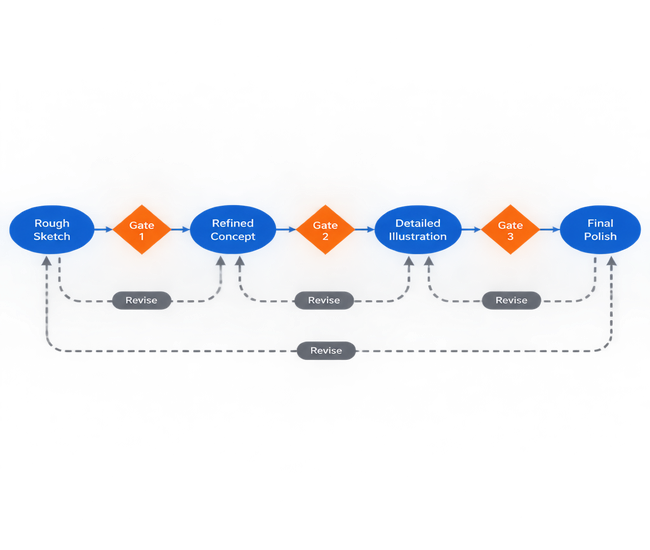
1. Concept Thumbnail
Here, the client chooses the overall composition, character pose, and focal point. Once they review the rough layouts, they submit their first consolidated revision round to lock in the big picture.
2. Refined Line Art
At this gate, the artist confirms that the clean drawing carries out those approved thumbnail decisions. If the package includes three rounds, the client uses one here; in a two-round package, this serves as a verification checkpoint to obtain written approval before any painting begins.
3. Color Block-In
The client reviews the flat palette and large color relationships across the piece. They use their second included revision round at this stage to dial in the mood and brand alignment.
4. Final Render
The artist completes the lighting, texture, and polish, then delivers the final proof for sign-off and file handoff.
Locking in approvals at each gate stops expensive backtracking dead in its tracks. Once line art is approved, a new pose requested during shading becomes a separately quoted scope change because it reopens foundational drawing and rendering work. You should record each sign-off in a dated email or project thread identifying the exact proof version, such as "Line art v2 approved." Pair each gate with a proposed 1-to-2-business-day review window, and state clearly that late feedback moves the final delivery date according to your next available production slot.
Buyers love structure when they see how it protects their launch date. During onboarding, frame these boundaries as a reliable roadmap: "We settle composition first, drawing second, and color third, so you can make each decision before I build the next layer." Also, be sure to separate corrections of an artist's failure to follow the approved brief from client-requested creative changes. If you accidentally draw four fingers instead of five or miss a requirement listed in the original brief, fix that on your own dime and state that correction policy explicitly upfront.
Minor Tweak vs. Scope Creep: Defining What Counts as a Single Change
Even with stage gates in place, a project can go sideways if you and your client define a "revision" differently. A round of revisions must be defined by the feedback batch, never by the number of individual stylus marks changed.
Specifically, one round means a single, consolidated list of adjustments submitted at one time against an identified proof, followed by one revised proof from the artist. Twelve separate emails spread over four days do not constitute a usable feedback batch.
Clear contract definitions also separate stage-appropriate tweaks from full redraws:
- Color Stage Included Revision: At Color Block-In, exchanging a warm palette for cool tones while retaining the approved composition.
- Color Stage Scope Change: Replacing the commissioned portrait with a full-body scene and a detailed background after flat colors are laid down.
- Drawing Stage Included Revision: Adjusting the mouth or eyebrow expression during the scheduled drawing round without rebuilding the head angle.
- Drawing Stage Scope Change: Requesting a brand-new head angle after the drawing has already been approved and rendered.
When drafting your service terms—alongside standard ownership clauses outlined in resources like the U.S. Copyright Office circular on works made for hire and commission agreements, put your revision mechanics in plain English. You can adapt this baseline clause for your own proposals:
"The fee includes two revision rounds: one at Concept Thumbnail and one at Color Block-In. Each round consists of one consolidated written feedback submission and one revised proof. Written approval closes that stage. Requests that alter approved composition, pose, deliverable dimensions, or background complexity will receive a separate written quote and revised schedule before work begins."
Whenever a request crosses into extra work, follow a strict authorization routine: describe the requested change, quote its exact cost and delivery impact, and obtain written acceptance before picking up your stylus. Because contract enforcement varies by location, always have custom legal templates reviewed for your relevant local commercial jurisdiction before using them with paying clients.
Training Clients to Give Consolidated, Problem-Focused Feedback
Most buyers aren't art directors. When they spot something slightly off in a proof, their default reaction is to micro-direct the fix: "Move that line two millimeters left and make the shadow 10% darker."
Projects tend to move faster when you train clients to describe the communication problem instead of prescribing the technical fix. Start by asking the client at kickoff to appoint one primary feedback contact who gathers all internal stakeholder comments, resolves contradictions behind the scenes, and sends the single agreed response.
When they do send notes, guide them to articulate the brand issue, such as "the character looks too serious for our playful brand." That gives you the creative breathing room to explain and execute the right visual solution—like softening the eyebrows and lifting the mouth corner at the drawing stage, without wrecking the anatomy of the piece.
Make this effortless for the buyer by embedding a short prompt directly inside your proof delivery email rather than attaching a separate worksheet. Remind them which stage they are approving, note the proposed 1-to-2-business-day response window established during onboarding, and paste these four lines:
Proof Review Guide: 1. What should this image communicate? 2. What currently gets in the way? 3. Which changes are essential for approval? 4. Please combine all stakeholder comments into one reply and identify the proof version.
For location-specific comments, ask the client to send an annotated proof or use an unambiguous reference like "the character's left eyebrow" rather than dropping scattered screenshots without version labels. Once the edits are made, record the final consolidated request and the resulting approval in the exact same project thread so the next production stage has a clean, traceable starting point.
Open your current commission agreement or proposal template right now, delete the word "unlimited," and paste in the two-round stage-gate clause above before you send out your next client quote.












Join the Conversation
Nothing here yet. Add your opinion.
Add Your Thoughts