
Trade the Dream Desk for the Kitchen Table
The elaborate homework room looks lovely in photos. It has labeled drawers, matching wall files, a tiny lamp, and perhaps a motivational banner with suspiciously perfect lettering. It can also destroy focus by sending a child into another room, away from easy help and the household rhythm already happening after school.
A temporary station at the kitchen table works differently. It appears when homework begins, gives every supply a clear job, and disappears before dinner. A parent can answer a quick fractions question while chopping vegetables. A child can ask for help without leaving the assignment, searching the house, or calling from a bedroom.
The whole station needs only three things: a portable caddy, a flat surface, and a strict two-minute cleanup rule.
A Ten-Minute Setup, Start to Finish
Clear one seat and enough table space for an open workbook plus one sheet of paper. Place the caddy on the child’s dominant-hand side so reaching for a pencil does not send an elbow sweeping across the page.
- 0:00–2:00: Clear the seat, wipe the surface, and put down the focus mat.
- 2:00–5:00: Gather pencils, an eraser, scratch paper, and a small set of coloring tools.
- 5:00–7:00: Add the visual focus cue, such as a placemat or cardboard shield.
- 7:00–10:00: Open the first assignment and arrange a short task list.
That sequence turns setup into a predictable runway. Nobody spends twenty minutes decorating pencil cups while the math folder remains zipped inside a backpack.
Keep Help Nearby
Shared space creates passive supervision. Adults can notice a stalled worksheet or a wandering pencil without hovering over every answer, and children can ask small questions before frustration grows teeth.
The kitchen table may be busiest right before dinner. When that happens, move the same kit to a counter, coffee table, or cleared floor desk. Keep the caddy, focus cue, and cleanup sequence identical so the routine survives the location change.
Raid the Pencil Drawer Before Buying Anything
Start with a house scavenger hunt, minus the shopping cart. Check the pencil drawer, school bags, printer shelf, and craft bin. The goal is to assemble the station today using supplies already within reach.
Choose tools by how often assignments require them. A sparkly stamp set may be delightful, but it contributes very little to Tuesday’s spelling sheet.
The Small Supply List That Covers Real Homework
- Three to five sharpened pencils that write without wobbling or scratching through the paper
- One dependable eraser that removes graphite instead of smearing it into a gray cloud
- Ten to twenty sheets of scratch paper, including clean-backed printer pages that can be reused
- Four to eight markers or crayons for diagrams, headings, maps, and elementary worksheets
Spend a few minutes gathering those items. Use no more than another couple of minutes to test pencils, toss dried markers, and remove anything likely to become a toy. A giant rainbow of gel pens gives a child dozens of tiny decisions before the actual work begins. A short color set still handles the assignment while keeping the evening moving.
I use a simple filter here: if a supply does not appear in the current week’s homework, it stays in the craft bin.
This compact paper-based setup fits most elementary and middle-school assignments. Laptop-heavy high-school work needs a nearby power source, reliable internet access, and enough table depth for both a computer and reference materials. The same portable routine still helps, though the surface must accommodate the extra gear.
Skip the Craft Avalanche
Keep decorative tape, novelty scissors, loose glitter, and large marker collections out of the caddy. Homework supplies should make the next action obvious rather than opening a surprise art studio.
Draw a Focus Boundary in a Busy Room
The kitchen table comes with clattering dishes, passing siblings, snack negotiations, and somebody opening the refrigerator for the fourth time. Treat those distractions as a layout problem.
Begin with a distinctive placemat or paper desk mat roughly 12 to 18 inches deep. This creates a visible work boundary: workbook and paper stay inside; toys, mail, and half-eaten toast stay outside. Using the same mat each day also gives the routine a visual opening signal.
Block Movement Without Building a Fortress
If activity in the room keeps pulling the child’s eyes away, unfold a trifold cardboard privacy shield behind the work area. A shield around a foot to a foot and a half high can soften peripheral movement while leaving the child visible and connected to the room.
A shipping box can become a perfectly useful shield. Cut away the top and bottom flaps, leave three panels attached, and stand it behind the workbook. Let the child add one drawing or a name label if that creates a sense of ownership, then stop. This object has a job to do.
Set up the complete focus zone in a few minutes. Face the seat away from the television when possible, and avoid positioning it toward the busiest doorway. The shield should reduce visual traffic rather than hide the child in a cardboard cave.
Use Light and Posture to Keep Energy Up
Choose a chair that allows the child to sit upright with the workbook easy to see. A saggy couch encourages sleepy reading and awkward handwriting. At a table, scoot the chair close enough that forearms can rest naturally without shoulders creeping toward the ears.
Use steady overhead light or a nearby lamp that illuminates the page without throwing a hand-shaped shadow across it. Right-handed children usually benefit from light arriving from the left; left-handed children benefit from the reverse.
Finish the zone with a checklist of three to five concrete actions. “Do homework” feels enormous. “Read directions,” “finish questions 1–5,” and “pack folder” give the child visible stepping stones.
Protect the Work Edge
Leave enough clear room to turn a workbook page without knocking over the caddy. A defined boundary should contain the work, not squeeze it into a postage stamp.
Turn a Shoebox into a Grab-and-Go Caddy
Portability is the secret weapon. A permanent desk gathers unrelated objects because it is always available. A portable caddy arrives with a purpose, supports the assignment, and leaves when the job is done.
The container can be humble. A plastic shower caddy offers a built-in handle and divided sections. Shoeboxes cost nothing and slide easily onto a closet shelf. Small rolling utility carts work when assignments require thicker books or a laptop charger, provided the cart has a short, unobstructed route to the table.
Give Every Tool a Visible Home
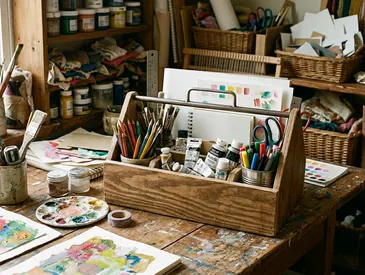
Place two or three short containers inside the caddy. Use one for pencils and the eraser, another for markers or crayons, and an optional third cup for a ruler, scissors, or glue needed by current assignments. Low plastic cups often work better than heavy or breakable containers.
Visibility matters. When pencils stand upright, a child can spot one and start. When everything tumbles into a deep box, finding an eraser becomes an archaeological dig involving three broken crayons and a glue-stick cap.
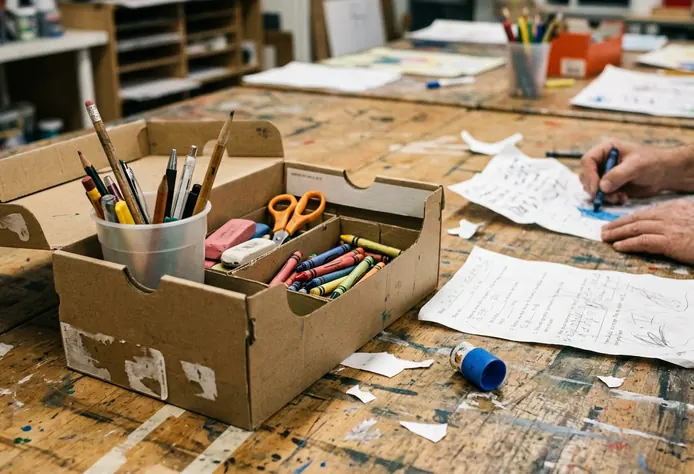
A tall glass jar can also make a lightweight shoebox unstable. Replace it with a low plastic cup if the container tips during the carry test.
Test the Journey, Not Just the Shelf
Fill the caddy and ask the child to carry it from its designated storage spot to the table and back. This quick, minute-or-two test catches problems that tidy shelf styling misses. Watch whether the container lands flat, whether upright cups tip, and whether the child can manage it without adult rescue.
If carrying requires two hands plus assistance, remove supplies. The child should be able to launch the homework routine independently, even if an adult remains nearby for questions.
- Keep the heaviest items low and near the center.
- Store loose paper flat beneath the cups or in a slim folder.
- Remove tools that repeatedly spill, snag, or migrate around the box.
- Choose one shelf or closet spot as the caddy’s permanent parking place.
A good caddy may look ordinary. Its charm appears around 4:15 p.m., when it reaches the table in one trip and every pencil is ready.
Let the Caddy Announce Homework Time
Children rarely walk through the door ready to switch directly from school effort to another worksheet. Build a decompression buffer into the routine before the caddy appears.
Allow somewhere between twenty and forty-five minutes for a snack, movement, and changing clothes. Use the shorter end when the evening schedule is tight. This buffer needs a clear finish, since an open-ended break can quietly become the entire afternoon.
Repeat the Same Opening Sequence
The physical appearance of the caddy should trigger a familiar series of actions:
- Finish the decompression break.
- Carry the caddy to the work surface.
- Place the focus mat and open the assignment.
- Read the short checklist.
- Start the timer and begin the first small task.
That sequence shifts the burden away from repeated verbal reminders. The station itself becomes the cue. A child sees the mat, the upright pencils, and the open checklist, then knows exactly what happens next.
Keep the opening task tiny. Reading the directions is a better first step than confronting an entire packet. Once the child has a pencil moving across the page, the transition is already underway.
Make the Timer Boring and Useful
A kitchen timer or simple visual timer can divide the work into 10- to 20-minute blocks with short breaks of a few minutes. Put it where the child can see it without touching it repeatedly. The timer should answer “How long?” rather than becoming a new gadget to poke.
During a break, stand up, stretch, refill water, or walk one lap around the room. Leave the worksheet open and the caddy in place. This keeps the pause connected to the work session instead of turning it into a full reset.
When the next block begins, point to the next checklist action. The child returns to a specific verb such as “solve,” “read,” or “pack,” which feels far more manageable than being told to “focus.”
Close Every Session with the Two-Minute Reset
The entire system falls apart when the homework station stays on the table overnight. Papers mix with dinner mail, pencils wander into other rooms, and tomorrow begins with a search party.
Cleanup matters more than perfect compartments. The next session depends on finding usable tools immediately, so reset the station within two minutes after the final assignment ends.
The Countdown Back to Ready
- First half minute or so: Throw away scraps, stack completed papers, and put school pages into the correct folder.
- Next minute: Return tools to their cups and sharpen two or three pencils for the next day.
- Final few seconds: Fold the mat or shield, lift the caddy, and return everything to its designated shelf or closet.
Do this before anyone leaves the table. Waiting until after dinner invites supplies to scatter, and leaving the job until morning turns a clean start into a chore.
The reset also creates a satisfying endpoint. Homework has a visible beginning when the caddy arrives and a firm ending when it goes away. The kitchen table becomes family space again, while tomorrow’s station waits fully loaded on its shelf.
Reset Before Dinner
Do not chase a showroom-perfect caddy. Remove trash, restore the essential tools, sharpen the pencils, and store the container. Ready beats pretty every school night.
Make the two-minute reset nonnegotiable: pack the caddy away immediately after the last assignment, every single day.










Join the Conversation
Nothing here yet. Add your opinion.
Add Your Thoughts