
When the Refrigerator Magnet Finally Gives Up
On a Tuesday afternoon, a heavy plastic magnet finally loses its grip on the refrigerator door. Twenty layers of finger-painted construction paper, macaroni collages, and crumpled spelling worksheets slide onto the linoleum. Somewhere beneath the pasta, a permission slip makes its escape.
The magnet has become the household’s entire storage system. It deserves a smaller job.
A manageable children’s art gallery rests on four decisions: give incoming work one holding zone, let the child choose a fixed number of monthly keepers, photograph textured projects before dismantling them, and install matching front-opening frames for easy rotation. For an already trimmed sheet, a thirty-second swap makes a useful convenience target.
Think of the collection as an illustrator’s sketchbook: warmups, experiments, and finished compositions share the same pages, while a smaller selection reaches the portfolio. A child’s wall display benefits from that same editing. Leaving space around a remarkable purple horse gives everyone a chance to notice its magnificent spaghetti legs.
The familiar refrigerator display still has a place. Moving the main collection onto a deliberate wall gives the kitchen breathing room and the artwork a clearer audience. Start with the available space, then build a routine that fits it.
Let Six Wall Spaces Make the Monthly Decision
Backpack-unpacking time already has enough moving parts. Asking for a permanent decision about every worksheet adds another negotiation precisely when everyone wants a snack.
Separate arrival from selection. Place a shallow wire basket or clear file box beside the unpacking spot, sized to hold the child’s largest routine school paper without folding it. All incoming artwork lands there. The basket gives papers a temporary address without requiring an immediate verdict.
Give the Child the Curator Hat
On the final weekend of each month, set aside a suggested 10–15 minutes to spread out the basket’s contents. Show the child the display boundary first: this gallery has six positions. The wall supplies the limit; the child supplies the choices.
A pretend curator hat can help make the review feel like an exhibition meeting. Ask questions that point toward decisions an artist actually makes:
- “Which painting has the boldest colors?”
- “Which drawing took the longest to figure out?”
- “Which one has a story you want to remember?”
Once the six positions have their selections, identify any milestone piece headed for the physical archive. Record the child’s explanation, name, and creation month on a separate archive slip or in the photograph caption. “That’s the dog waiting outside the moon bakery” preserves something a date alone cannot.
School-age children may enjoy negotiating their selections. Toddlers and preschoolers often care more about making the next picture; adults can handle routine thinning after bedtime while retaining pieces the child specifically values.
Keep Six Visible
Leave the display capacity steady between reviews. A growing row of extra clips quietly turns the gallery back into a paper pile.
Catch the Crayon Shine Without the Kitchen Glare
A small capture station beside a window can handle both flat drawings and lumpy classroom masterpieces. Overhead recessed kitchen lights tend to put the phone’s shadow directly over the paper, while waxy crayon catches distracting reflections.
For softer light, try a north-facing window in the Northern Hemisphere or an open sliding door on an overcast afternoon. Turn off overhead lamps to avoid mixing their color with daylight. Keep the phone and the photographer’s body out of the incoming light path.
- Start flat. Lay a drawing on the floor and hold the phone directly above it, parallel to the sheet. Check that the edges look straight and the whole page is sharp.
- Give sculpture some depth. Put a popsicle-stick sculpture, cotton-ball cloud, or clay pinch pot on white poster board or a neutral wood surface. Photograph it at approximately 45 degrees, then take another view for details hidden behind the front.
- Check before clearing. Look closely at focus and color before the original moves to storage, reuse, or disposal.
- File immediately. Add the photographs to an album named “2025 - Maya - Art,” using the relevant year and child’s name. A caption such as “October - two-headed dragon - age 7” makes later searching easier.
The album also gathers material for an end-of-year printed photo book. Keep original-resolution files in a separate backup location before discarding an object; a phone album organizes pictures but does not create another copy.
The Library of Congress preservation guidelines for family paper and drawings explain how acidic paper deteriorates and light exposure can damage paper collections. Inexpensive newsprint is particularly vulnerable, and colored construction paper can fade. These household photographs provide a practical visual record; they cannot promise exact color matching or a fixed lifespan for the originals.
Find the Painting Inside the Paint Explosion
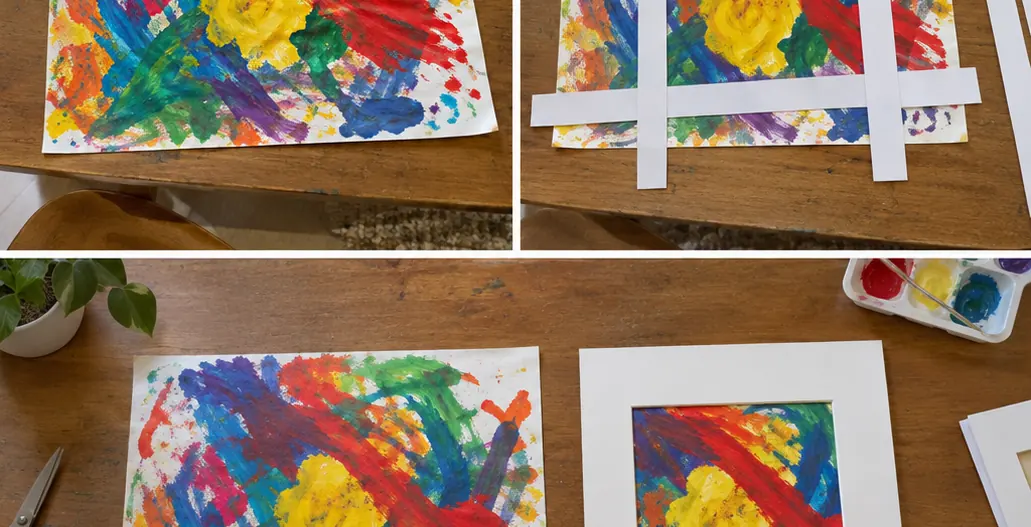
Two clean paper strips make a useful movable window. Slide them across an 18-by-24-inch tempera painting until an intersection of brushstrokes catches the eye: perhaps a red sweep crossing a thick yellow puddle. Mark an 8-by-10-inch rectangle around that composition.
Photograph the complete original first. Then an adult can trim it with a rotary paper trimmer, or use a sharp craft knife with a cutting mat and metal straightedge. The tighter crop gives the strongest marks room to lead.
Representational drawings need a different conversation. Ask about the tiny dog in the corner before drawing a cut line. Its size says little about its importance to the story, and the child may want every whisker included. A larger frame or clip display can accommodate that decision.
Give Small Drawings a Wide White Border
A 4-by-4-inch marker doodle can hold its own inside an 11-by-14-inch frame with a generous white mat. Order or cut the opening slightly smaller than the paper so the mat overlaps its edges. The white space separates the drawing from the surrounding room and gives those small marks visual weight.
For a multi-frame wall, sort by dominant color before arranging. Warm reds and oranges can gather in the hallway; blues and greens can share the playroom. Repeating the frame finish supplies another steady visual element, even when the pictures feature wildly different subjects.
Ask About the Dog
Let the child identify the essential details before trimming a narrative drawing. A neat fit should preserve the story they meant to tell.
Choose Frames, Wire, or Clipboards for the Actual Paper
Measure the wall and the artwork before buying hardware. Compare local prices for six complete display positions, including mats and mounting supplies. A frame-only price leaves part of the project out of the comparison.
Front-Opening Frames for a Quiet Hallway Grid
Matching hinged magnetic frames suit living areas where a tidy, glazed display matters. They open like a book, so a prepared sheet can slide into place without taking the frame down. Compare the visible opening, accepted paper size, backing depth, and stated storage capacity.
Some models advertise room for twenty older sheets behind the displayed piece; check the individual product rather than assuming every frame offers that capacity. Choose shatter-resistant glazing for low, child-accessible displays, and follow the manufacturer’s mounting method.
Curtain Wire for Oversized and Odd-Shaped Work
A tensioned steel curtain wire with mini bulldog clips accommodates large paintings and paper-plate creatures without trimming. It suits a playroom wall or narrow niche where varied outlines feel at home. Keep the same six-piece boundary if this becomes the household’s main display.
Securely anchor the end fittings. Fresh paint should stop dripping before hanging, with a washable surface beneath it during drying.
Clipboards for Straightforward Weekly Swaps
A measured clipboard grid keeps the mechanism visible and easy to understand. Clipboards intended for US letter paper accept 8.5-by-11-inch sheets without the trimming an 8-by-10-inch opening requires. This option suits a household that values quick changes over a glazed finish.
For removable adhesive mounting, weigh each clipboard with its paper attached, follow the strip’s surface and load instructions, and observe its bonding time. Mark any layout with paper templates, then test one complete swap before installing the remaining positions.
One Portfolio Under the Bed, One Dragon on the Wall
Every piece leaving the wall needs a destination. Return it to the current review batch, move a milestone original into the archive, or repurpose it after photography. That small routing decision keeps the kitchen counter clear.
Give each child one flat, acid-free portfolio sized for the largest original the household intends to keep. An under-bed spot works if it stays dry and away from direct sunlight. When the portfolio fills, spread out its contents together and choose what leaves before adding another piece.
Save the Milestones
Keep the physical archive selective. A drawing with a memorable story or a newly mastered detail earns its space through meaning, rather than simply arriving most recently.
Colorful abstract sheets still have useful jobs ahead. Cut sturdy painted paper into gift tags, wrap a grandparent’s birthday present in an oversized easel painting, or fold suitable sheets into thank-you cards. Before recycling leftovers, separate clean paper from macaroni, plastic decorations, foil, and other attachments according to local guidance.
The final Sunday of the month can hold the main selection session. An optional 2–5-minute Sunday check handles straightening or swapping a piece already chosen.
On a quiet Sunday afternoon, a seven-year-old climbs a broad, nonslip wooden kitchen step-stool while an adult steadies it. The child unclips a faded autumn leaf rubbing from a low clipboard, slides a neon green drawing of a two-headed dragon under the clip, and steps back to check whether it hangs straight. The adult returns the stool to its storage spot. Both dragon heads face the kitchen.











Join the Conversation
Nothing here yet. Add your opinion.
Add Your Thoughts