
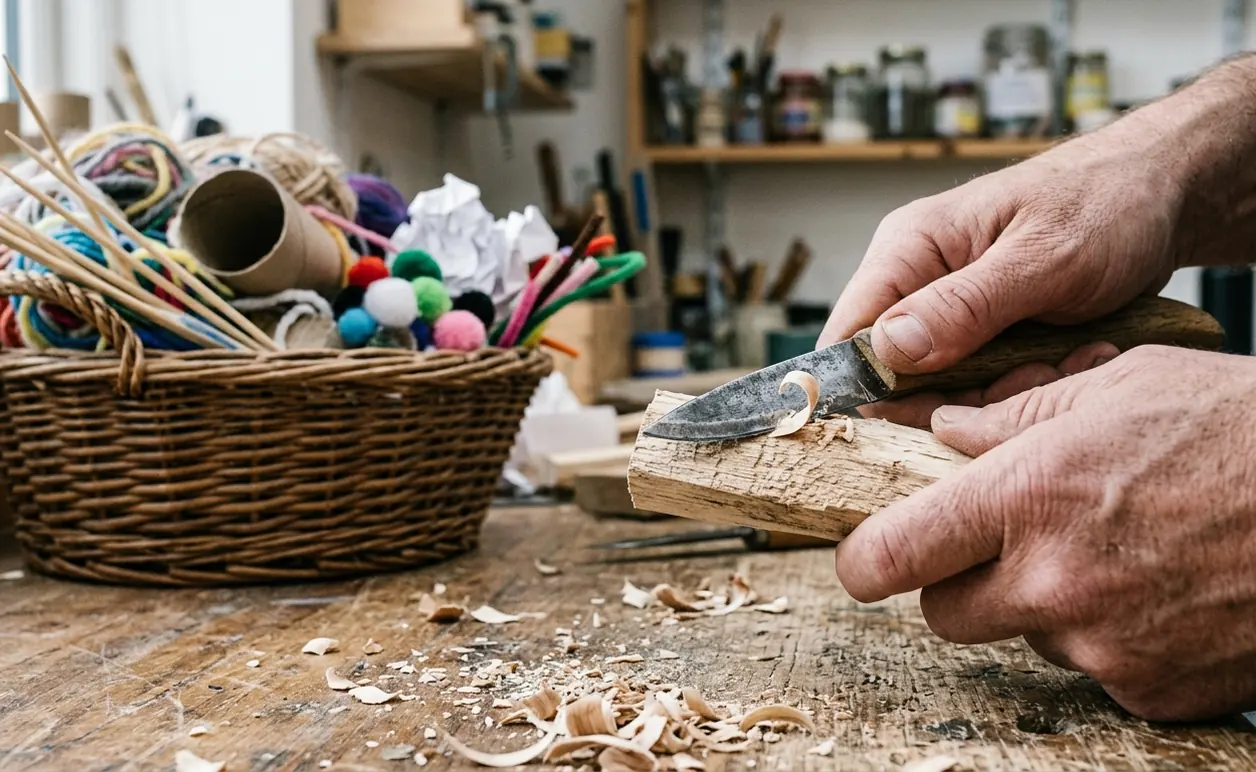
What Changes When Adults Stop Curating Play?
What happens to a child’s imagination when adults stop curating every minute of playtime?
The immediate answer may involve groaning, flopping onto the carpet, and a dramatic announcement that there is “literally nothing to do.” Given time, though, a useful shift begins. The child has to scan the room, choose a material, and decide what it could become.
Endless shelves of Pinterest-perfect activity bins can crowd out that decision. Each bin arrives with a theme, an approved use, and often an adult example hovering over the whole affair. Reducing those visible choices transfers the creative decision from the adult to the child.
Simplifying the setup is a deliberate parenting choice. It gives children room to define the subject, combine materials, revise a weak idea, and invent rules. Those small decisions form the real work of creative problem-solving.
Start with four material categories: paper, tape, cardboard, and markers. Try the setup during three to five play periods across a week or two. Watch for making, combining, or assigning roles to objects without a request for a prepared activity. A cardboard rectangle becoming a bakery counter says more than a tidy row of completed worksheets.
The Hidden Work Inside a Pre-Planned Craft
Modern parenting culture can make a Tuesday afternoon feel like an unpaid art-direction job. There are sensory bins to coordinate, seasonal crafts to photograph, and educational activities that somehow require twelve tiny containers. The preparation often takes longer than the child’s interest lasts.
A structured craft begins with an adult-owned concept. Someone chooses the reference image, prepares the pieces, specifies the assembly order, and defines the finished result. In illustration terms, the child receives a tightly specified brief. Even with a Wacom tablet and polished technique, executing that brief differs from originating the character, composition, and visual story.
Instruction-led projects can still serve a clear purpose. They help when a child is learning safe tool handling or practicing a specific technique. The argument here concerns imaginative play, where the child needs opportunities to make the compositional decisions.
Audit the Four Decisions
Before opening a kit, ask who controls four things: the subject, the materials, the construction sequence, and the definition of completion. When the instructions control all four, replication becomes the main task. The child may practice careful assembly, yet the central idea has already been settled.
For a practical comparison, alternate one instruction-led project with one blank-paper session across a few craft periods. Give the open session roughly half an hour. Look at the kinds of decisions produced in each: copying and assembly in one, then self-generated characters, structures, or game rules in the other. Direct research connecting boredom itself with children’s creativity remains more limited than the adult experimental literature, so this small observation works best as a household comparison rather than a sweeping test.
Getting Through the Complaint-to-Construction Gap
The hardest part usually arrives before anything interesting gets built. External entertainment stops, the child protests, and the adult feels an almost magnetic urge to suggest a pirate ship, fetch a printable, or turn on a show. Rescuing the moment ends the exact mental work the pause was meant to invite.
“You do not know what to do yet.”
That response acknowledges the feeling while leaving the problem with the child. The word yet matters. It frames the empty moment as temporary and solvable without slipping a project idea into the conversation.
Hold a No-Rescue Window
Set a defined interval of 10 to 20 minutes. During that window, offer no new screen, toy, printable, or suggested theme. Stay nearby and available, but quiet. Step in for safety or genuine help with a tool; leave the choice of project alone.
- Acknowledge the complaint without debating it.
- Keep the available materials visible and limited.
- Allow wandering, staring, and restless material handling.
- Wait while the child tests a fold, a strip of tape, or a cardboard join.
- Let the resulting object grow into an invented game or story.
This sequence may look gloriously inefficient. That is part of its value. Passive waiting gradually gives way to scanning, testing, constructing, and assigning meaning.
Repeat the routine a few times over a week or two before judging it. Familiarity reduces the surprise of the boundary. The adult stops acting as an entertainment dispenser, while the child gains practice crossing the uncomfortable gap under their own steam.
Four Supplies That Leave Room for Big Ideas
A useful open-ended art kit can fit on one shelf. Choose supplies by function: a surface for drawing and folding, a connector, a structural material, and a mark-making tool. Specialized pieces tend to solve construction problems in advance; ordinary materials leave those problems deliciously unresolved.
Build the Small Toolkit
- Paper: 10 to 20 sheets of A4 or US-letter printer paper
- Tape: one roll of masking tape, around two centimetres wide
- Cardboard: two to four plain pieces or boxes
- Markers: six to twelve basic colors
Leave the materials accessible for an hour or so and skip the project prompt. Soon, practical puzzles appear. How can flat paper stand upright? Can one strip bridge two boxes? What reinforces a floppy wall? Could masking tape become a hinge?
Material limits create productive friction. A perfectly matched kit provides the correct tab for the correct slot. Two mismatched boxes demand measurement, testing, and perhaps a lopsided cardboard brace that somehow works. The child has to discover what the material can do.
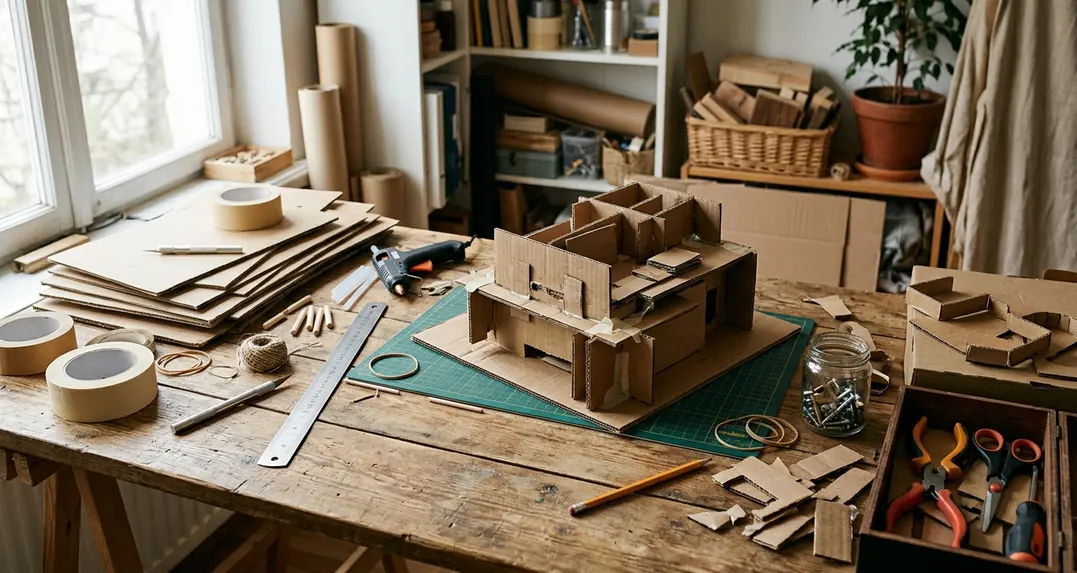
Adults can control safe tool access and still preserve the blank-box boundary. The child decides whether the box becomes a puppet theater, an animal clinic, or a machine with seventeen marker-drawn buttons.
Let the Cardboard Castle Come Down
The strongest measure of a childhood art session is the trail of decisions. A wall collapsed. The child folded another layer into it. Then the story changed when the roof became a ramp. A scrap that looked useless turned into a ticket, tail, flag, or tiny sandwich.
Count Revisions, Not Keepsakes
After a build of half an hour or so, ask the child to identify one failed attempt and one change that improved the construction. The question keeps attention on thinking and revision. It also gives children language for the part of creativity that happens between the first idea and the workable one.
The finished object can be photographed, displayed briefly, dismantled, or recycled. Keep it for a day or two when the child wants to. Permanent shelf status adds little to a project whose richest moments happened during folding, joining, collapsing, and rebuilding.
A plain box asks the child to supply nearly everything: purpose, setting, characters, rules, and plot. That imaginative workload explains why such a humble object has endured beside far more elaborate toys. In 2005, the simple cardboard box was officially inducted into the National Toy Hall of Fame.








Join the Conversation
Nothing here yet. Add your opinion.
Add Your Thoughts